Engineering screening tool + decision guide · By AMRGearbox · Published · Reviewed
Inspection Robot Drivetrain Sizing
Screen torque, speed and battery demand for advanced inspection robotics. Start with a preset, then edit your mission.
Drivetrain calculator
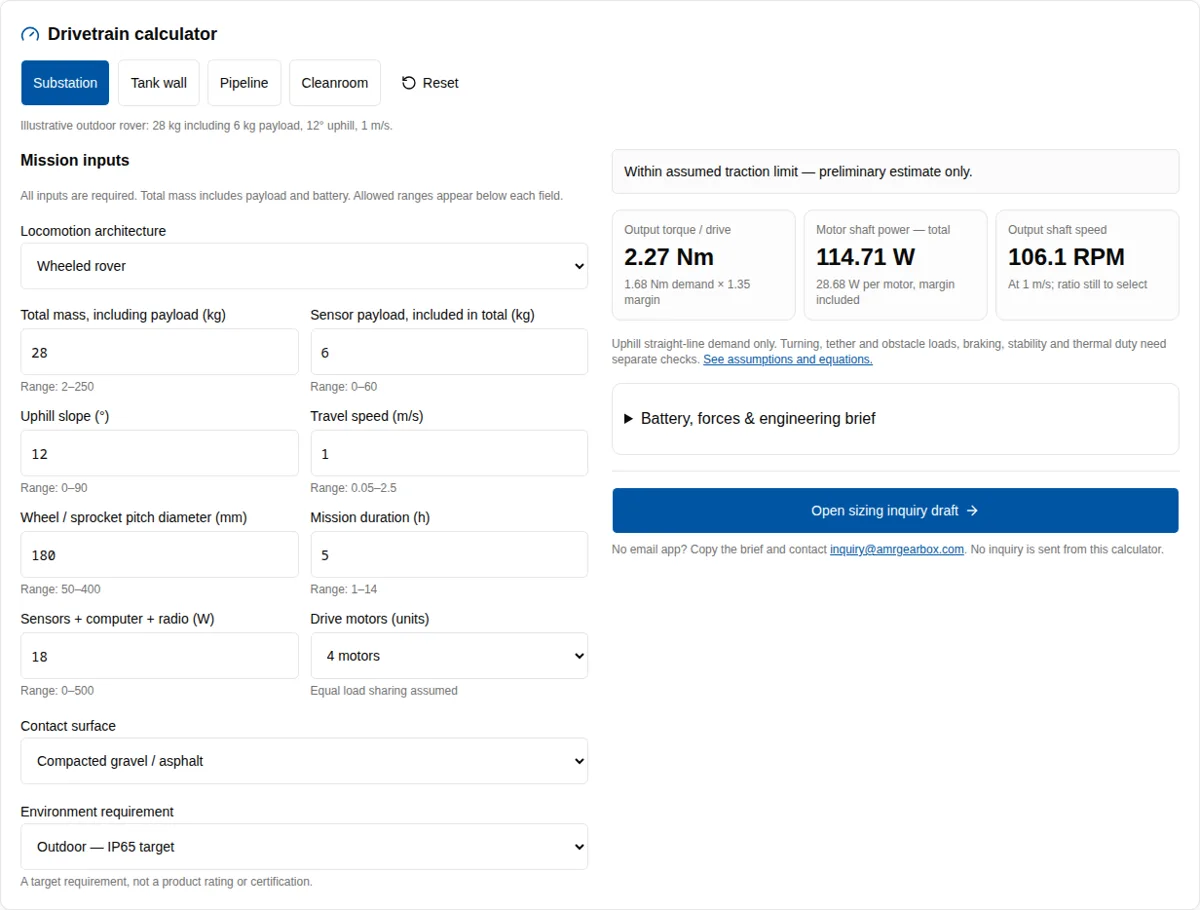
Illustrative outdoor rover: 28 kg including 6 kg payload, 12° uphill, 1 m/s.
Within assumed traction limit — preliminary estimate only.
Output torque / drive
2.27 Nm
1.68 Nm demand × 1.35 margin
Motor shaft power — total
114.71 W
28.68 W per motor, margin included
Output shaft speed
106.1 RPM
At 1 m/s; ratio still to select
Uphill straight-line demand only. Turning, tether and obstacle loads, braking, stability and thermal duty need separate checks. See assumptions and equations.
Battery, forces & engineering brief
Nominal battery budget
955.98 Wh
5 h; 80% usable fraction
System energy / distance
42.49 Wh/km
Includes drive electrical input + auxiliaries
24 V nominal capacity
39.83 Ah
Alternative bus voltage
48 V nominal capacity
19.92 Ah
Alternative bus voltage, same energy
Electrical power budget: 152.96 W
Blue: drive 134.96 W. Green: auxiliaries 18 W.
Constant uphill load including acceleration and margin; this is a conservative scenario budget, not a measured runtime curve.
Force demand: 74.78 N total
Contact-friction capacity: 201.44 N under the selected assumptions. Turning, tether and obstacles are excluded.
Architecture candidates
Planetary geared drive candidates. Compare continuous and peak torque, speed, bearing loads and thermal duty against a specific supplier data sheet.
IP65 target — dust / water jets; no immersion approval. Hazardous-area suitability not assessed.
Copy the brief or open an email draft. Opening a draft does not send an inquiry.
No email app? Copy the brief and contact [email protected]. No inquiry is sent from this calculator.
Key decisions before requesting a gearbox
The tool answers an initial load question. This guide explains which decisions the numbers can support, which inputs require measurement and which approvals need separate evidence.
Decision summary: conclusion, basis and next action
Decision
Basis / evidence
Action
Check contact traction before adding motor power
Force balance in the method below; coefficients are illustrative assumptions.
Measure contact friction and turning loads on the actual surface.
Separate propulsion torque from safe holding
SEW self-locking guidance; applying it to crawlers is our engineering recommendation.
Validate power-off brake, adhesion and independent fall restraint.
Specify immersion conditions rather than a universal depth
IEC 60529 classification and manufacturer-specific IPX8 conditions.
Request the complete-assembly report with depth, time, fluid and shaft state.
Keep screening separate from site qualification
ISO non-electrical Ex scope and IEEE substation recommended practice.
Confirm applicable editions, atmosphere and acceptance tests with the site owner.
Engineering recommendation: complete each verification step before purchasing a drivetrain.Software execution captured 2026-10-25: wheeled rover, 28 kg total including 6 kg payload, 12° slope, 1 m/s, 180 mm wheels, gravel/asphalt, 5 h, 18 W auxiliaries and four motors. Calculator crop only; site navigation is excluded. This records a reproducible software run, not a hardware test or customer result.
Match locomotion to the asset
Architecture comparisons below are engineering screening judgments, not tested product rankings. A pipe crawler may use wheels or tracks; its confinement and retrieval requirements make it a separate mission category.
Locomotion choices and missing validation
Architecture
Useful starting scenario
Main limitation
Alternative / validation
Wheeled rover
Accessible substation paths and factory aisles
Steps, loose ground, available contact friction and tipping
Survey routes; compare larger wheels or tracks on representative obstacles.
Tracked crawler
Uneven ground and low-speed load distribution
Turning scrub, wear and obstacle torque excluded from this model
Measure skid-turn current; compare steering wheels if the route allows.
Magnetic crawler
Ferromagnetic tank or hull surfaces
Coating gap, plate thickness, peeling and power-loss recovery
Pull-off and slip tests; brake and restraint validation; compare a remotely positioned probe.
In-pipe crawler
Restricted conduits requiring a retrieval cable
Bends, cable drag, liquid pressure and stranded-vehicle retrieval
Test complete route and tether; compare push-rod inspection for short runs.
Select the reducer from a load spectrum
Reducer tradeoffs: compare specific data sheets
Candidate
Reason to consider
Evidence to request
Cost / reliability tradeoff
Planetary
Compact coaxial wheel or sprocket drive
Continuous and peak torque, efficiency map, radial load and thermal limits
Check whether added output support bearings erase packaging savings.
Strain wave
Sensor positioning where low lost motion matters
Loaded pointing error, stiffness, output bearing moment and fatigue duty
Precision can add cost without improving a wheel traction task.
Cycloidal
High reduction or repeated load transients
Actual shock rating, ripple, backdrivability and bearing limits
Validate low-speed sensor vibration and brake arrangement.
Worm
Right-angle packaging or high reduction
Forward efficiency, heat rejection and backdrive behavior across conditions
Heat and energy losses may increase battery and enclosure cost; no safe-holding guarantee.
Ratio = loaded motor speed ÷ required output RPM. The calculator has no motor speed input, so it does not invent a ratio range. Treat equal motor load sharing as an assumption; turning or uneven ground can overload one drive. SEW-EURODRIVE — limits of worm self-locking
Reproducible elementary mechanics, not a standard-certified sizing procedure. Total mass includes payload. Motion is straight uphill at the entered speed with an assumed 0.2 m/s² acceleration load carried throughout the energy budget. Constant worst-route loading and a service margin can overestimate energy; omitted obstacles, heaters and tether loads can underestimate it.
Equations used by this calculator
Output
Equation and units
Boundary
Normal / slope force
N_g = m g cosθ; F_s = m g sinθ, newtons; g = 9.80665 m/s²
No load transfer, center of gravity or tipping calculation.
Additional magnetic clamp
M = max(0, 2.5 m g sinθ / μ_contact − N_g), N
Static slip screen only. No acceleration, rolling safety factor or peeling qualification.
Tractive force
F = F_s + c_rr (N_g + M) + m × 0.2, N
M = 0 for ground vehicles. Track turning, tether, steps and probe drag excluded.
Constant-load budget. No idle/motion split, charging losses, aging or temperature derating.
Illustrative surface assumptions — replace with measured data before procurement
Surface
Rolling resistance c_rr
Contact friction μ
Known / unknown
Smooth concrete
0.018
0.65
Assumed for comparison; wetness, tread, steel gap and contamination not measured.
Compacted gravel / asphalt
0.045
0.75
Assumed for comparison; wetness, tread, steel gap and contamination not measured.
Muddy outdoor ground
0.085
0.5
Assumed for comparison; wetness, tread, steel gap and contamination not measured.
Ferromagnetic steel — magnetic only
0.04
0.4
Assumed for comparison; wetness, tread, steel gap and contamination not measured.
A ground vehicle exceeds this screen when F > μ_contact × N_g. No fixed safe slope follows from architecture alone. Magnetic outputs remain marked unverified even when the assumed contact capacity exceeds demand, because peel stability and measured adhesion are unknown. Service margin 1.35 and static adhesion margin 2.5 are screening choices, not mandated safety factors.
Ingress requirements need test conditions
Ingress targets — no product approval is inferred
Target
Meaning for this screen
Request before selection
Indoor industrial
No automatic IP target
Dust, cleaning, fluids and temperature requirements.
IP65
Dust and water-jet protection target; immersion not inferred
Assembly scope, connectors, shaft seals and test report.
IP67
Dust and temporary immersion target
Immersion conditions; separate evidence for jets, hot water and chemicals.
IP68
Dust and agreed continuous-immersion conditions
Depth / pressure, duration, fluid, temperature and whether shafts operate during the test.
The auxiliary field covers sensors, compute and radio power; mass does not predict electrical watts. Obtain maximum and mission-average consumption from the selected payload data sheets, including warm-up, heaters and transmission peaks. The preset 18 W is an illustration, not a typical payload guarantee.
Payload integration checklist — numerical budgets remain unknown until specified
Payload
Mechanical input
Electrical / inspection input
Unknown to confirm
Optical / thermal PTZ
Mass, mast moment, pointing stiffness
Average / peak power; movement and heater duty
Loaded image stability and inspection distance.
LiDAR + computer
Mount vibration, center of gravity
Processor load and sensor power in the actual mode
Localization reliability and total compute watts.
Ultrasonic probe
Contact force, couplant and articulation drag
Qualified NDT procedure and acquisition rate
Calibration, coupling, scan pitch and usable speed.
Gas sensing
Sampling head and tubing loads
Pump/heater power and alarm response
Target gas, response time and hazardous-area suitability.
Changing auxiliary power changes battery demand without changing torque. Changing payload alone leaves torque unchanged because total mass already includes it. Increase total mass when adding physical payload.
Four worked scenarios — illustrative, not customer deployments
Each scenario uses the same calculator and assumptions shown above. Outputs are model estimates, with no claims of measured field performance, certification, inspection resolution or cost savings.
Substation
Illustrative outdoor rover: 28 kg including 6 kg payload, 12° uphill, 1 m/s.
Process: resolve slope and contact loads, distribute output torque and apply the declared power/energy assumptions.
Screen result: 2.27 Nm per drive with margin, 106.1 RPM, 955.98 Wh nominal.
Decision: Within assumed contact limit; validate omitted loads and environment before choosing a model.
Tank wall
Illustrative magnetic crawler: 18 kg, vertical steel, 0.15 m/s. Adhesion and hazardous-area approval require separate validation.
Process: resolve slope and contact loads, distribute output torque and apply the declared power/energy assumptions.
Screen result: 7.57 Nm per drive with margin, 28.65 RPM, 415.76 Wh nominal.
Decision: Conditional demand only; qualify adhesion, holding, retrieval and the hazardous-area assembly.
Pipeline
Illustrative 12 kg crawler at 25° uphill. Tether, couplant and sludge resistance are not modeled.
Process: resolve slope and contact loads, distribute output torque and apply the declared power/energy assumptions.
Screen result: 1.64 Nm per drive with margin, 53.05 RPM, 331.3 Wh nominal.
Decision: Within assumed contact limit; validate omitted loads and environment before choosing a model.
Cleanroom
Illustrative 20 kg flat-floor inspector, 0.7 m/s. Particle emissions require testing of the assembled robot.
Process: resolve slope and contact loads, distribute output torque and apply the declared power/energy assumptions.
Screen result: 0.36 Nm per drive with margin, 95.49 RPM, 275.14 Wh nominal.
Decision: Within assumed contact limit; validate omitted loads and environment before choosing a model.
Substation operation: acceptance and EMC are separate checks
IEEE 3328-2025 addresses wheeled substation inspection operation, acceptance and maintenance. IEC 61000-6-5:2015 covers immunity of electrical/electronic equipment in power station and substation environments. Their public scope pages do not establish a universal enclosure attenuation, encoder type or safe approach distance.
Engineering recommendation: agree an installation-specific test plan with the utility covering motor control, telemetry, sensor accuracy and recovery after communications loss. Request test reports with setup, ports and performance criteria. An optical encoder or resolver still needs system-level verification; neither is assumed immune.
Hazardous atmospheres: flag the requirement, verify the assembly
ISO 80079-36 addresses non-electrical ignition hazards; ISO 80079-37 describes non-electrical protection methods. These scopes support assessing the gearbox as well as electrical equipment. They do not require every assembly to use all protection methods or establish that a material, seal or nominal service factor makes a robot explosion-proof.
Before procurement, have a qualified assessor confirm the actual atmosphere, applicable conformity route, equipment scope, temperature class, ambient range and special conditions of use. Product certificates and assembly suitability are unknown until supplied and reviewed. This page makes no ATEX/IECEx product certification claim.
Risks, cost tradeoffs and recovery planning
Failure and cost review — proposed checks, not a certified FMEA
Risk
Decision impact
Mitigation / alternative
Misuse: drive torque treated as a holding rating
Uncontrolled rollback or detachment
Test power-loss holding; separately validate brake, adhesion and restraint.
Scenario mismatch: pipe turns and tether omitted
Stalled crawler with costly retrieval
Measure full-route pull load; compare shorter runs or a lighter tether.
Cost: custom interfaces vs standard drive
Adapters, bearings, qualification and spares may dominate unit price
Quote complete assemblies for the same load spectrum and documentation requirements.
Reliability: seal and lubricant mismatch
Ingress, corrosion or thermal damage
Verify fluid/temperature compatibility; inspect per supplier and site conditions.
Inspection: mobility works but sensor data fails
Repeat visits and missed defects
Validate on representative reference defects; use an alternate inspection method if data fails.
Build TCO from quoted purchase/integration cost, validation, maintenance, retrieval risk and downtime. Savings, payback, MTBF and replacement intervals are unknown without project data; no universal dollar saving or maintenance schedule is claimed.
Public source pages checked . Standards catalog scopes are traceable references, not a substitute for the full applicable editions, test procedures or product certificates. Calculated values, coefficients and illustrative scenarios are identified separately from source-backed scopes.
Manufacturer states that self-locking cannot be the sole safety function for hoists; crawler brake and restraint selection still require their own assessment.
Consistent condition coding and assessment of pipelines, laterals and manholes; not a drive or tether specification.
Unknowns before model selection: measured surface friction, load sharing, real efficiency maps, duty spectrum, adhesion/peeling stability, ingress test conditions, thermal performance, product approvals, inspection accuracy and service life. Provide measurements or request engineering review rather than treating these estimates as an approved specification.
Inspection robot and advanced inspection robotics FAQ
20 questions
What is an inspection robot?
A mobile or crawling platform carries cameras, thermal imagers, ultrasonic probes or other sensors to inspect an asset. Navigation, sensor qualification and site access requirements depend on the application; a drivetrain estimate covers only one subsystem.
How does advanced inspection robotics differ from a warehouse AMR?
Advanced inspection robotics adds an inspection task and asset-specific access requirements to mobility. Depending on the site, that may involve climbing, tethered operation, sensor positioning, ingress protection or hazardous-area assessment. These features and certifications are not universal.
Which gearbox should I screen for a wheeled rover?
A planetary reducer is a candidate where coaxial packaging suits the chassis. Compare supplier continuous and peak torque, bearing loads, loaded speed, efficiency and thermal duty. The calculator does not select or qualify a specific product.
Is a harmonic reducer necessary for the sensor mast?
It is one candidate for high reduction and low lost motion. Compare it with planetary or direct drives using loaded pointing error, torsional stiffness, wind moment and cable routing. No universal backlash or vibration figure is assumed here.
Can a worm or cycloidal reducer prevent a vertical crawler falling?
Do not rely on gearbox reduction as a fall-prevention guarantee. Verify a power-off brake and independent restraint, together with adhesion and peeling stability. SEW warns that worm self-locking is not permitted as the sole safety function for hoists; applying that caution to crawlers is an engineering recommendation.
Does the displayed torque already include a service margin?
The primary torque card shows output torque per drive with a 1.35 screening margin. Its sublabel shows the unfactored demand. Output torque is not motor-shaft torque: divide by the chosen ratio and gearbox efficiency for a first motor-torque estimate, then check the duty cycle.
Does selecting Zone 1 certify this robot?
No. The selection records a requirement. Assess electrical and mechanical ignition hazards, the actual atmosphere, temperature class, ambient range and complete assembly. ISO 80079-36 and -37 address non-electrical Ex equipment and protection methods; they are not evidence that any listed product is approved.
No fixed 20 m rating follows from IP68. Obtain the manufacturer-agreed depth, duration, fluid and operating conditions, including moving shafts and connectors. Product-specific immersion conditions are essential.
IP67 concerns dust protection and temporary immersion. Obtain separate evidence for the actual jet pressure, temperature, chemicals and cleaning procedure; an immersion rating alone does not establish washdown suitability.
No. Total mass already includes the sensor payload, battery, chassis, drive and cables carried by the robot. Payload is a subset used for a mass-ratio warning. Entering it again would double-count its weight.
Why can sensor power dominate battery size on flat floors?
Rolling power can be small at low speed, while computers, sensors and radios continue consuming electricity. Enter measured or supplier-budgeted auxiliary watts. The 18 W preset is illustrative and may be far too small for GPU computing, heaters or powerful payloads.
Can the tool guarantee ultrasonic inspection resolution?
No. Probe coupling, material, calibration, scan pitch, positioning and the approved NDT procedure determine usable measurements. Choose travel speed with the inspection specialist and validate it on a representative specimen.
What should I include in a gearbox inquiry?
Send the input and result brief, plus motor loaded speed, voltage, continuous/peak duty, envelope drawing, bearing loads, expected quantity, environment and required test documentation. List unknown requirements explicitly.
Are custom interfaces and certificates already confirmed?
No. Request confirmation of shaft, flange, seal, lubricant and documentation availability for the quoted model. A screening result is not a stock, lead-time, cleanroom or hazardous-area certification promise.
Does a drivetrain estimate establish autonomous operation?
No. Localization, communications loss, obstacle detection, emergency stops, docking and operator recovery require their own acceptance tests. Choose autonomous or teleoperated operation from the site risk assessment and mission.
Can a service factor predict gearbox life or MTBF?
No. A 1.35 screening margin is an assumption, not a life calculation. Request a supplier calculation using the load spectrum, bearing forces, speed, lubricant, temperature and maintenance plan. Bearing rating life and system MTBF are different quantities.
Does API 653 require robotic ultrasonic scanning at a fixed speed?
The linked public API scope concerns tank inspection and repair qualifications. It does not substantiate a universal robotic scanning method, travel speed or thickness resolution. Confirm the applicable edition and inspection procedure with the asset owner and NDT specialist.
IEEE 3328-2025 is a recommended practice for wheeled substation inspection robots. Its public summary covers system composition, scenarios, operations, acceptance and maintenance. It does not substantiate a universal 80 dB shield or resolver requirement. Use installation-specific EMC testing.
For a straight horizontal run, a first estimate is F = μ × cable mass per metre × g × length. With assumed μ = 0.30, 0.35 kg/m and 250 m, the estimate is 257 N. Bends, reel tension, buoyancy and sludge change the load. Tether drag is excluded from this calculator; measure pull force before selecting a drive.
Does PACP prescribe crawler ingress or drive specifications?
The NASSCO public program describes consistent condition assessment and coding. It is not evidence for a universal IP68 rating, drive count or tether force requirement. Specify equipment separately from the inspection-data workflow.