
ISO 3691-4 Compliance: How Gearbox Choice Impacts AMR Safety Certifications
A procurement and engineering guide to ISO 3691-4 safety brakes, performance levels (PLr d), and redundancy in AMR gearboxes.
Navigating the safety and compliance landscape is one of the most resource-intensive phases in developing an Autonomous Mobile Robot (AMR). While sensors, LiDAR, and software stacks often dominate the functional safety conversation, the mechanical drivetrain—specifically the gearbox and braking system—is the ultimate executor of every safety command.
Under the stringent ISO 3691-4 standard, which governs the safety requirements for driverless industrial trucks and their systems, the braking and deceleration mechanisms must meet explicit Performance Levels (PL). For procurement and engineering teams, specifying a gearbox without aligning it to ISO 3691-4 requirements can result in costly redesigns, failed certifications, and delayed market entry.
In this deep-dive guide, we will analyze the direct impact of gearbox selection on ISO 3691-4 compliance, map out the mechanical realities of Performance Level requirements, and provide a clear framework for sourcing compliant drivetrain components.
1. The Shift from EN 1525 to ISO 3691-4: Why Gearboxes Matter More Now
For years, the industry relied on EN 1525 as the baseline for AGV safety. However, EN 1525 was written before the explosion of free-navigating AMRs. ISO 3691-4, published to address the unique complexities of dynamic, infrastructure-free navigation, fundamentally shifts how risk assessments are conducted.
A primary focus of ISO 3691-4 is Functional Safety (often referencing ISO 13849-1). The standard demands that when an AMR detects a human or obstacle in its protective field, it doesn't just "try" to stop—it must execute a guaranteed, predictable deceleration under all rated environmental and payload conditions.
Because the gearbox is the physical link between the braking mechanism (often integrated into the motor or the gearbox input shaft) and the driving wheel, any mechanical failure, excessive backlash, or structural weakness in the gearbox directly compromises the robot's ability to achieve the required stopping distance.
2. Deciphering ISO 3691-4 Braking Requirements (PLr d vs. PLr b)
ISO 3691-4 evaluates safety functions based on the severity of potential injury and the probability of occurrence, assigning a Required Performance Level (PLr). For AMRs, the braking system is bifurcated into two distinct safety functions:
Safety Function 1: The Primary Braking System (Deceleration)
- Requirement: PLr d (High reliability, capable of preventing severe injury)
- Function: Controls the dynamic deceleration of the vehicle when an obstacle is detected in the safety zone or during an Emergency Stop (E-Stop).
- Gearbox Implication: The gearbox must transmit the braking torque instantly without catastrophic tooth shearing. Backlash must remain tight enough to prevent "lurching" or delayed stopping distances. The structural integrity of the gearbox housing must withstand repetitive shock loads from sudden stops at maximum velocity and payload.
Safety Function 2: The Parking Braking System
- Requirement: PLr b (Lower risk, prevents unintended motion)
- Function: Engages to hold the vehicle stationary (e.g., on an incline) once it has stopped.
- Gearbox Implication: The gearbox must not back-drive unexpectedly under static load. If the parking brake is mounted on the motor side (before the gear reduction), the gearbox must hold the multiplied torque without creeping.
3. Structural Limits: When the Gearbox Becomes the Single Point of Failure
Even if you source an electrical motor and safety brake certified to IEC 61800-5-2 (covering functions like SBC - Safe Brake Control), a sub-standard gearbox will negate these certifications.
Overhung Load (Radial Load) and Shaft Snapping
High-payload AMRs (1,000kg+) place immense radial loads directly on the gearbox output shaft. If a sudden PLr d E-Stop occurs, the dynamic weight transfer exponentially spikes the overhung load. If the gearbox bearings are undersized or the shaft material lacks sufficient yield strength, the shaft can snap. If the shaft breaks, the wheel detaches from the braking mechanism entirely, and the AMR becomes a free-rolling projectile—a catastrophic failure of ISO 3691-4 compliance.
Backlash Degradation and Stopping Distance
Stopping distance calculations required by ISO 3691-4 are rigid. If a gearbox wears prematurely and develops excessive backlash (e.g., from 3 arc-min up to 15 arc-min), the mechanical "slop" delays the application of braking force to the wheel. In a worst-case scenario, this delay can add centimeters to the stopping distance, causing the AMR to breach its safety zone and fail compliance audits over time.
4. Visualizing Functional Safety in AMR Drivetrains
To achieve true PLr d compliance, redundant and monitored systems must work in unison.
5. Performance Levels vs. Mechanical Realities
How do the electrical/control mandates of PLr translate into physical gearbox specifications?
| ISO 3691-4 Safety Function | Standard Requirement | Real-World Gearbox Parameter | Minimum Procurement Spec |
|---|---|---|---|
| Primary Braking (PLr d) | Bring vehicle to a safe halt from max speed before obstacle impact. | Peak Shock Torque Tolerance | Gearbox must withstand 3x to 5x nominal torque without tooth yielding. |
| Primary Braking (PLr d) | Predictable, repeatable stopping distance over 5+ years. | Backlash Stability | Initial backlash < 5 arc-min. Wear rate guaranteed < 20% over 10,000h. |
| Safe Stop 1 (SS1) & SBC | Brakes safely arrest the drivetrain during faults. | Housing & Shaft Rigidity | High-tensile steel output shafts; heavy-duty tapered roller bearings for radial load. |
| Parking Brake (PLr b) | Prevent unintended motion while powered off or charging. | Static Back-driving Resistance | Ensure the reduction ratio and brake holding torque combo securely anchors maximum payload on rated inclines. |
6. Safe Brake Test (SBT) and Gearbox Wear
Modern drives utilize a Safe Brake Test (SBT)—a diagnostic function where the drive occasionally applies torque against the engaged brake to verify its holding capacity. While this is excellent for proving the brake meets ISO 13849-1 diagnostic coverage requirements, it subjects the gearbox to repeated, high-torque micro-stresses.
If the gearbox's planetary carrier or cycloidal pins are made from inferior alloys, these daily SBT diagnostics will induce micro-fractures, eventually leading to catastrophic failure. Procurement must verify that the gearbox fatigue life calculations include SBT cycles, not just normal continuous driving.
7. Procurement & Engineering Checklist for ISO 3691-4 Gearboxes
To avoid integration nightmares and compliance failures, use this checklist when vetting gearbox suppliers for your AMR fleet:
- Peak Torque Verification: Can the supplier provide certified test data showing the gearbox surviving hundreds of E-Stops at maximum payload velocity without internal fracture?
- Radial Load Documentation: Is the output shaft bearing specifically rated to handle the dynamic weight transfer of the AMR during hard braking?
- Backlash Wear Curve: Does the manufacturer guarantee the backlash will not exceed your stopping-distance tolerance over the B10 life of the robot?
- Brake Integration: Are the input flanges designed to perfectly mate with safety-rated servo motors and brakes without introducing tolerance stack-up?
- Traceability: Does the supplier offer batch traceability and material certificates? (Critical for ISO 9001 and risk mitigation files).
- Environmental Sealing (IP65+): Will fluid ingress (e.g., in food & beverage AMRs) degrade the lubricant, lower efficiency, and unexpectedly lengthen the stopping distance?
8. Frequently Asked Questions (FAQ)
Does ISO 3691-4 require a specific type of gearbox?
No. ISO 3691-4 is a functional safety standard, meaning it dictates how the system must perform, not what parts to use. You can use planetary, cycloidal, or harmonic gears, provided the entire system meets the required Performance Levels and stopping distances.
Can we just rely on the brake manufacturer's PLr d certificate?
Absolutely not. The brake certificate only covers the brake. The standard requires a system-level risk assessment. If a PLr d brake is attached to a mechanically weak gearbox, the system will fail the risk assessment because a single mechanical fault (a snapped shaft) leads to a total loss of the safety function.
How does gearbox efficiency impact safety?
Low efficiency implies high internal friction. While friction can aid braking, unpredictable changes in efficiency due to temperature fluctuations or wear make stopping distances inconsistent. Predictable, high-efficiency gearboxes ensure that the braking algorithms designed by the safety PLC perform reliably every time.
Should we use integrated wheel drives or separate motor/gearbox units?
Integrated wheel drives (where the gearbox, motor, and brake are a single unified hub) are increasingly popular because the manufacturer typically guarantees the structural integrity of the entire unit under braking loads. Separate components require the AMR OEM to validate the mechanical interface between the brake, motor, and gearbox themselves.
What happens if an AMR fails a stopping distance test during commissioning?
If the stopping distance exceeds the safety zone programmed into the LiDAR/sensors, you must either slow the AMR down (destroying productivity and ROI) or enlarge the safety zone (which makes navigating tight aisles impossible). Selecting a rigid, low-backlash gearbox prevents this scenario.
9. Conclusion: Safety as a Mechanical Absolute
Software can detect obstacles in milliseconds, and safety PLCs can trigger brakes instantaneously, but the laws of physics are ultimately enforced by the gearbox. A gearbox that fails under the shock load of an E-Stop, or one that introduces sloppy backlash into the drivetrain, transforms a highly intelligent AMR into an uncontrollable mass.
For procurement and engineering leaders, aligning drivetrain sourcing with ISO 3691-4 isn't just about ticking boxes for a CE mark or UL certification. It is about protecting the end-user's personnel, safeguarding the robot's physical assets, and guaranteeing that the fleet operates at maximum speed and maximum productivity without compromise.
Verifiable Sources & Further Reading
- ISO 3691-4:2023 - Industrial trucks — Safety requirements and verification — Part 4: Driverless industrial trucks and their systems. (Primary international standard for AMR safety).
- ISO 13849-1 - Safety of machinery — Safety-related parts of control systems. (Defines Performance Levels PLr b through PLr e).
- IEC 61800-5-2 - Adjustable speed electrical power drive systems — Part 5-2: Safety requirements. (Defines SBC and SBT functional safety).
- TÜV Rheinland & Applus+ Laboratories Technical Guidelines on Mobile Robot Certifications and Risk Assessments.
- ANSI/ITSDF B56.5 - Safety Standard for Driverless, Automatic Guided Industrial Vehicles and Automated Functions of Manned Industrial Vehicles.
Need guidance on selecting the right gearbox for your high-payload, ISO 3691-4 compliant AMR? Connect with our engineering team for a drivetrain risk assessment and bespoke integration support. Contact us via our RFQ portal or email [email protected].
Author
Categories
Need an AMR Gearbox Recommendation?
Reference this article and share your constraints. Our team replies via [email protected].
More Posts
Low-Noise Gearbox Design for Hospital and Retail AMR: Acoustic Engineering Guide
Low-noise gearbox engineering for hospital and retail AMR. Noise thresholds by environment, architecture comparison, and test protocols.

AMR Gearbox Sourcing Update (2026-W28): 25% Tariff Risk on Drive Modules
W28 AMR gearbox sourcing update: Proclamation 11032 changes Section 232 duty exposure for steel, aluminum, and copper derivative drive modules.
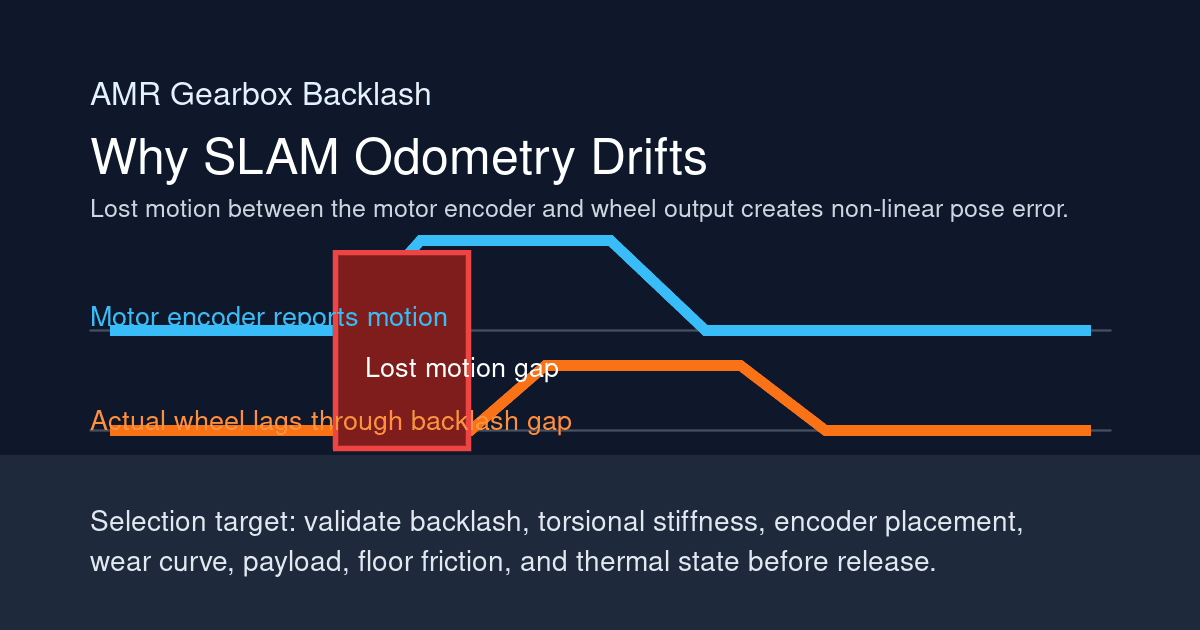
Solving SLAM Odometry Errors: How Gearbox Backlash Impacts AMR Navigation
How AMR gearbox backlash creates odometry drift, when SLAM can compensate, and what drivetrain specs engineers should request before buying.